
What Is a Keyword Density Checker?
A Keyword Density Checker is an SEO tool that measures how often a keyword appears in your content compared to the total word count. It helps writers, bloggers, marketers, and website owners understand whether they are using their focus keyword too little, too much, or in a balanced way.
For example, if your article has 1,000 words and your focus keyword appears 10 times, the keyword density is around 1%.
This does not mean every article must have exactly 1% keyword density. SEO is more complex than that. But keyword density can still be useful because it helps you identify two common problems:
- You forgot to use the focus keyword enough.
- You used the focus keyword too many times and the content sounds unnatural.
A good Keyword Density Checker should not encourage keyword stuffing. It should help you keep content natural, readable, and relevant.
For Realaiva, this tool is useful because many WordPress users care about Rank Math scores. Rank Math often checks whether the focus keyword appears in the content and whether the density is reasonable. A keyword density tool can help users fix that issue before publishing.
Why Keyword Density Still Matters
Keyword density is not a magic ranking formula. Google does not rank pages simply because a keyword appears a certain number of times. Modern SEO depends on search intent, helpful content, topical coverage, internal linking, authority, user experience, and many other factors.
However, keyword density still matters as a basic content quality check.
If your target keyword is Keyword Density Checker, but the article barely mentions that phrase, the page may look unfocused. Search engines and users may not clearly understand the topic.
On the other side, if you repeat Keyword Density Checker in every sentence, the content becomes hard to read and may look spammy.
The goal is balance.
In my opinion, keyword density should be used like a warning light, not a strict rule. If the keyword density is extremely low, you may need to make the topic clearer. If it is extremely high, you should rewrite the content naturally and use related terms.
How Our Keyword Density Checker Works
The Realaiva Keyword Density Checker should be built for practical SEO content optimization.
A useful version should include:
- Large text input box
- Focus keyword input
- Keyword density percentage
- Total word count
- Character count
- Sentence count
- Paragraph count
- Top keyword frequency table
- One-word keyword analysis
- Two-word phrase analysis
- Three-word phrase analysis
- Over-optimization warning
- Missing keyword warning
- Readability suggestion
- Export report option
- Copy optimized checklist

A Keyword Density Checker helps writers measure keyword usage and avoid over-optimization.
Example user input:
- Focus Keyword: AI Blog Title Generator
- Content Length: 1,200 words
- Keyword Count: 11 times
Possible result:
Keyword Density: 0.91%
Status: Good
Suggestion: Your focus keyword appears naturally. Add one use in an H2 if relevant.
This kind of output is helpful because it gives context, not just a number.
Who Should Use This Tool?
This Keyword Density Checker is useful for:
- Bloggers
- SEO writers
- Affiliate marketers
- WordPress users
- Rank Math users
- Ecommerce store owners
- Agencies
- Students learning SEO
- Website owners
- Content editors
- AI content reviewers

Checking keyword density helps bloggers keep content natural, readable, and SEO-friendly.
It is especially useful after writing with AI. AI-generated content sometimes repeats phrases too often. A Keyword Density Checker helps identify repetitive wording before publishing.
For example, if an AI article repeats “best AI tools” 45 times in 1,000 words, the content may feel robotic. The checker can reveal that problem quickly.
11 Powerful Ways to Use Keyword Density Correctly
- Use the Focus Keyword in the First Paragraph: Your focus keyword should appear near the beginning of your content. This makes the topic clear from the start.
- Add the Focus Keyword to at Least One Subheading: Rank Math often recommends using the focus keyword in a subheading. This also helps readers understand the page. Do not force the keyword into every heading. One or two natural placements are enough.
- Aim for Natural Keyword Usage: Some SEO tools suggest around 1% keyword density, but that should not be treated as a hard rule. If the keyword sounds forced, reduce it. Natural writing is more important than hitting an exact number.
- Use Related Keywords: Instead of repeating the same phrase again and again, use related terms. For Keyword Density Checker, related terms may include: keyword frequency, SEO content checker, content optimization, focus keyword, keyword usage, word count, phrase frequency, and keyword analysis. This makes the content richer and more natural.
- Check Keyword Stuffing: Keyword stuffing means repeating a keyword unnaturally to manipulate rankings. Bad example: “Our Keyword Density Checker is the best Keyword Density Checker because this Keyword Density Checker checks keyword density.” This is not helpful and damages readability.
- Review Top Repeated Words: A good Keyword Density Checker should show the most repeated words and phrases. This helps you find accidental repetition. For example, you may discover that your article repeats “powerful,” “best,” or “tool” too many times.
- Check Two-Word and Three-Word Phrases: Single-word analysis is useful, but phrase analysis is better for SEO. Examples include: AI tools, blog title, meta description, keyword density, and email subject line. These phrases tell you more about the content topic.
- Use the Keyword in Image Alt Text: Rank Math also recommends using the focus keyword in image alt text. Example:
Alt Tag: Keyword Density Checker dashboard for SEO content optimization. This is useful as long as the image actually matches the alt text. - Use the Keyword in the SEO Title and Meta Description: Your focus keyword should appear in the SEO title, meta description, URL slug, H1, first paragraph, at least one subheading, image alt text, and body content. This helps create a consistent SEO signal.
- Check Content After Editing: Keyword density can change after revisions. Always check again before publishing. You may remove or add sections, which can change the word count and density.
- Use Keyword Density as a Quality Check, Not a Ranking Trick: The purpose of keyword density is not to trick search engines. It is to make sure your content is focused, helpful, and naturally optimized.
Keyword Density Examples
Here is how different levels of keyword density look in practice:
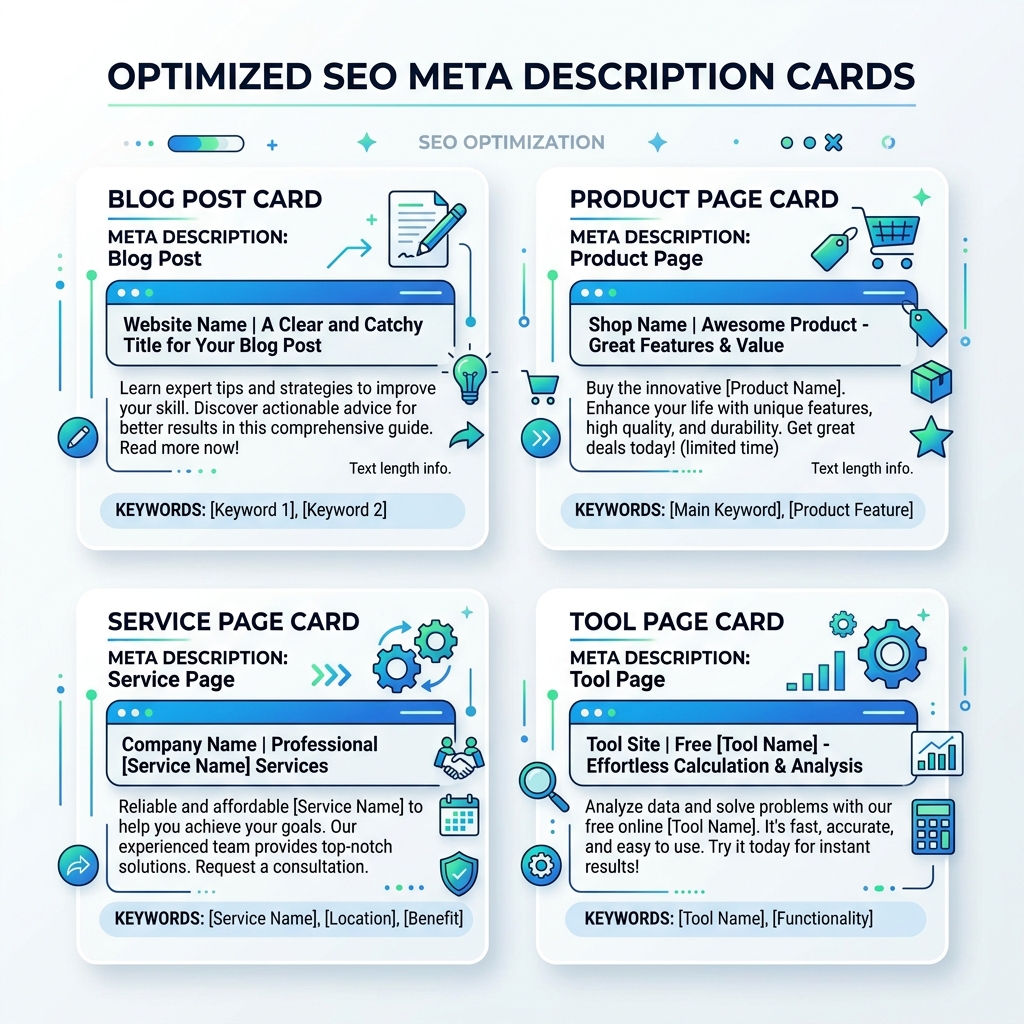
Good SEO writing uses keywords naturally instead of forcing them into every paragraph.
- Example 1: Good Keyword Density
Article Length: 1,200 words | Focus Keyword: Meta Description Generator | Mentions: 10 | Density: ~0.83%
This is usually natural if the keyword appears in the title, intro, subheading, and body. - Example 2: Low Keyword Density
Article Length: 1,500 words | Focus Keyword: AI Prompt Generator | Mentions: 2 | Density: ~0.13%
This may be too low. The article may need clearer focus. - Example 3: High Keyword Density
Article Length: 900 words | Focus Keyword: YouTube Title Generator | Mentions: 35 | Density: ~3.88%
This is likely too high. The content may feel repetitive and unnatural.
Common Keyword Density Mistakes
One common mistake is thinking keyword density alone can rank an article. It cannot. Your content still needs to satisfy search intent and provide useful information.
Another mistake is repeating the exact keyword too often. Use synonyms and related terms instead.
A third mistake is ignoring readability. If the content sounds awkward, the keyword usage is probably too forced.
Another mistake is checking only the main keyword and ignoring phrase repetition. Sometimes your focus keyword density is fine, but another phrase is repeated too much.
A final mistake is optimizing only for SEO tools. Rank Math is helpful, but your reader matters more. If the article is useful for users, it has a stronger chance of performing well.
Final Verdict
A Keyword Density Checker is a simple but powerful tool for improving SEO content. It helps you check whether your focus keyword appears enough, whether the content is over-optimized, and whether your writing sounds balanced.
My honest opinion is that every blogger using AI content should run a keyword density check before publishing. AI can write fast, but it often repeats phrases. A quick check can make the article feel more human and polished.
The best use of a Keyword Density Checker is not to chase an exact percentage. The best use is to make sure your content is clear, focused, readable, and naturally optimized.