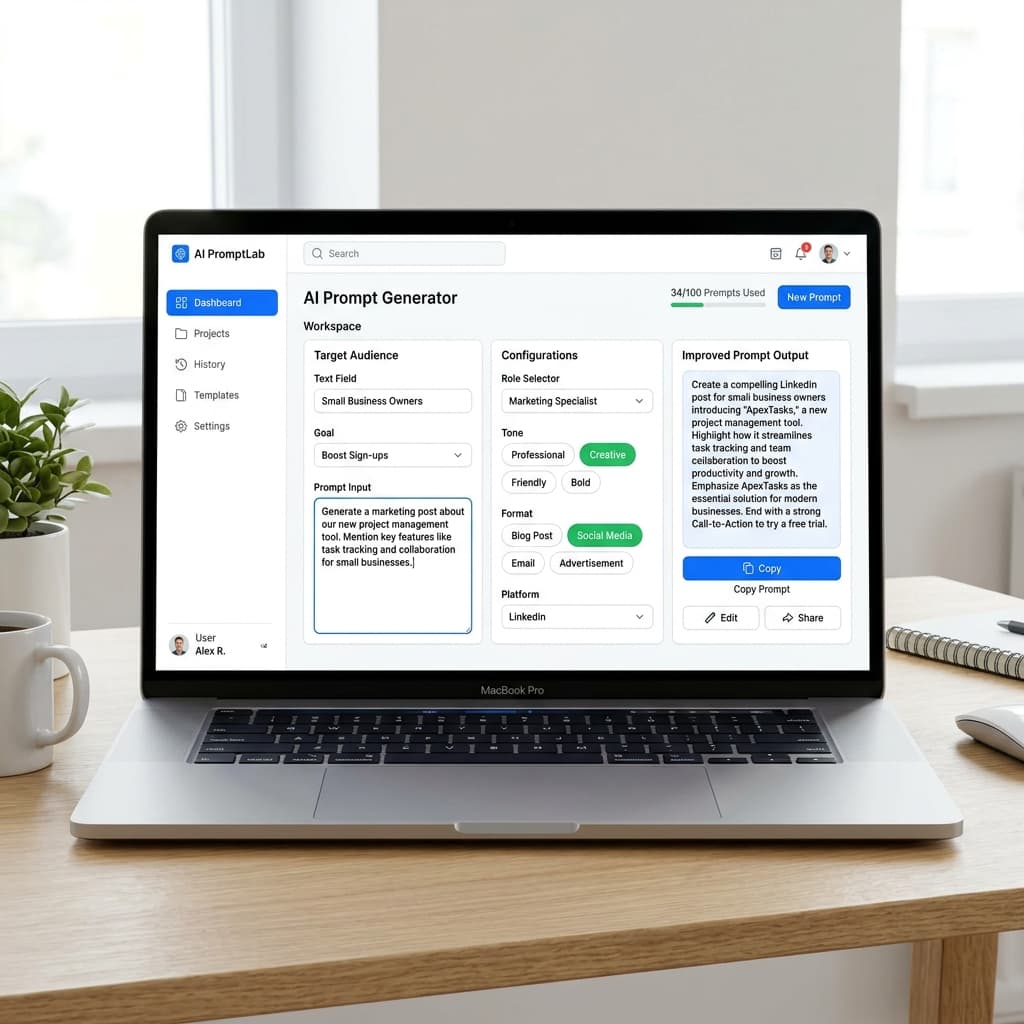
What Is an AI Prompt Generator?
An AI Prompt Generator is a tool that helps users create better instructions for AI tools like ChatGPT, Claude, Gemini, and other AI assistants. Instead of writing a short and unclear command, the tool turns your idea into a detailed prompt with role, task, context, format, tone, and output instructions.
For example, a weak prompt would be:
Write an article about AI tools.
A better prompt would be:
Act as an experienced SEO content writer. Write a 1,500-word beginner-friendly article about the best AI tools for students in 2026. Use short paragraphs, helpful examples, a comparison table, FAQs, and a natural human tone.
The second prompt is much stronger because it gives the AI more direction. It explains the role, topic, audience, format, length, and tone.
That is the main purpose of an AI Prompt Generator. It helps users get better AI results without needing to understand advanced prompt engineering.
Why Prompts Matter
AI tools are powerful, but they are not mind readers. The quality of the output depends heavily on the quality of the input. If your prompt is vague, the output will usually be generic. If your prompt is specific, the output is more likely to be useful.
A good prompt can improve:
- Accuracy
- Structure
- Tone
- Relevance
- Creativity
- Formatting
- Speed
- Consistency
In my opinion, many users blame AI tools when the real problem is the prompt. They ask for something broad, receive a broad answer, then assume the tool is not good. But when they give proper instructions, the quality improves dramatically.
For example, instead of asking:
Give me business ideas
Ask:
Give me 10 low-budget AI automation business ideas for a beginner in Pakistan who wants to earn $1,000/month. Include target clients, pricing, difficulty level, and first steps.
This prompt gives context, location, income goal, and output format. That makes the result much more practical.
How Our AI Prompt Generator Works
The Realaiva AI Prompt Generator should be designed to help normal users create expert-level prompts.
A strong version should include:
- Task input
- AI model selector
- Prompt category selector
- Role selector
- Tone selector
- Output format selector
- Audience selector
- Length selector
- Context field
- Advanced instructions
- Copy button
- Improve prompt button
- Prompt rating
- Example prompt library

Better prompts help AI tools produce more accurate, structured, and useful results.
Example user input:
- Task: Write a product description
- Product: 2026 digital planner
- Platform: Gumroad
- Tone: Professional and persuasive
- Output Format: Title, short description, long description, bullet points, FAQs
Generated prompt:
Act as an experienced ecommerce copywriter. Create a Gumroad product listing for a 2026 digital planner. Include a catchy product title, short description, long description, feature bullets, benefits, FAQs, and SEO tags. Use a professional but friendly tone and focus on productivity, goal planning, habit tracking, and digital organization.
This type of output is immediately useful.
Who Should Use This Tool?
This AI Prompt Generator is useful for:
- Bloggers
- Students
- SEO writers
- Digital marketers
- Developers
- Ecommerce sellers
- YouTubers
- Designers
- Freelancers
- Business owners
- Teachers
- Researchers
- AI automation builders

Prompt generators are useful for writers, marketers, students, developers, and business owners.
For Realaiva, this tool is very valuable because it connects with many of your existing content topics. You can use it for AI writing, AI SEO, AI marketing, product descriptions, blog outlines, YouTube titles, Pinterest pins, and business automation.
21 Powerful Prompt Types
- Role-Based Prompt: This tells the AI who to act as. Example: Act as a senior SEO strategist... Role-based prompts usually produce better results because they give the AI a clear perspective.
- Task-Based Prompt: This explains what you want done. Example: Create a blog outline for...
- Audience-Based Prompt: This tells the AI who the content is for. Example: Write this for beginner bloggers who use WordPress.
- Tone-Based Prompt: This controls the writing style (e.g. professional, friendly, persuasive, simple, academic, conversational).
- Format-Based Prompt: This tells the AI how to structure the answer. Example: Give the answer in a table with columns for tool name, use case, price, and best feature.
- SEO Prompt: Useful for content writers. Example: Create an SEO article outline using the focus keyword “AI Blog Title Generator.” Include H2s, FAQs, meta description, and internal link suggestions.
- Blog Writing Prompt: Example: Write a 1,200-word blog post with short paragraphs, examples, FAQs, and a human tone.
- Email Prompt: Example: Write a professional follow-up email to a client who watched my AI calling agent demo but has not replied.
- Product Description Prompt: Example: Write a persuasive product description for a monthly budget spreadsheet sold on Gumroad.
- YouTube Script Prompt: Example: Create a 5-minute YouTube script about the best AI tools for students. Include hook, intro, main points, and CTA.
- Pinterest Prompt: Example: Create 10 Pinterest pin titles and descriptions for a free Meta Description Generator. Use curiosity, benefit, and SEO keywords.
- Coding Prompt: Example: Act as a senior Next.js developer. Create a clean tool page structure for an AI Blog Title Generator with input form, output cards, and SEO metadata.
- Debugging Prompt: Example: Review this code and identify bugs, performance issues, and security risks. Explain fixes step by step.
- Research Prompt: Example: Research the top AI SEO tools and compare them by use case, pricing, strengths, and limitations.
- Comparison Prompt: Example: Compare ChatGPT, Claude, and Gemini for SEO content writing. Use a table and give a final recommendation.
- Business Idea Prompt: Example: Give me 10 AI automation service ideas for local businesses in Pakistan and UAE. Include pricing and difficulty level.
- Social Media Prompt: Example: Create 10 Instagram captions for an AI automation agency targeting real estate agents.
- Image Prompt: Example: Create a 16:9 modern SaaS hero image for an AI Tool Finder website with clean UI cards and blue/green accents.
- Resume Prompt: Example: Rewrite this resume summary for a junior developer applying for remote AI SaaS roles.
- Learning Prompt: Example: Explain SEO to a beginner using simple language, examples, and a step-by-step checklist.
- Repurposing Prompt: Example: Turn this blog article into 5 Pinterest pins, 3 LinkedIn posts, and 1 YouTube script.
Prompt Examples
- Writing Example:
Weak Prompt: Write about email marketing.
Better Prompt: Act as a senior digital marketing writer. Write a 1,200-word beginner-friendly article explaining email marketing, why it matters, how much it costs, common mistakes, and best tools. Use short paragraphs, examples, and FAQs. - Product Copywriting Example:
Weak Prompt: Make product description.
Better Prompt: Act as a Gumroad product copywriter. Create a product title, short description, long description, benefits, features, and FAQs for a monthly budget spreadsheet designed for students and freelancers. Use a persuasive but trustworthy tone. - Pinterest Example:
Weak Prompt: Give me Pinterest ideas.
Better Prompt: Create 10 Pinterest pin titles and descriptions for an AI Blog Title Generator. Use benefit-driven copy, curiosity, and simple language for bloggers and content creators.
Common Prompt Mistakes
One common mistake is being too vague. AI needs context. If you ask a broad question, you will likely get a broad answer.
Another mistake is not giving the desired format. If you want a table, checklist, article, JSON, or email format, say it clearly.
A third mistake is not defining the audience. Content for beginners should be different from content for experts.
Another mistake is asking AI to do too many unrelated things in one prompt. Break complex tasks into steps.
A final mistake is accepting the first output without editing. AI can help you move faster, but human review is still important.
Final Verdict
An AI Prompt Generator is one of the most useful tools for anyone using ChatGPT, Claude, Gemini, or other AI assistants. It helps users turn simple ideas into clear, detailed prompts that produce better results.
My honest opinion is that prompt quality is one of the biggest differences between average AI users and smart AI users. The tool is the same, but the instructions are better.
For Realaiva, this tool can become a strong traffic and engagement asset because almost every AI user needs better prompts. If you add categories, role selection, tone control, output format, and example prompt libraries, this tool can genuinely solve a user problem.
The best prompt is not necessarily long. The best prompt is clear.